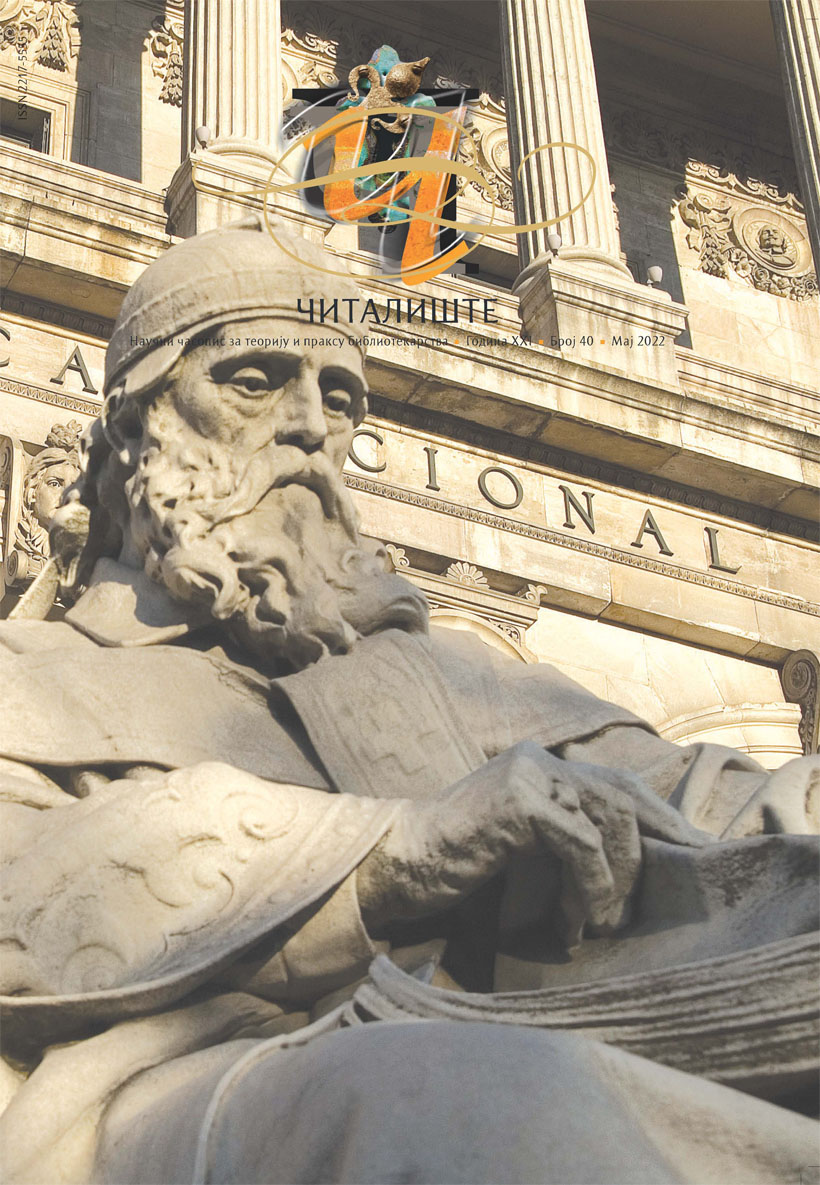
The National Library of Madrid and the Spirit of the Enlightenment

  • Владимир Карановић Универзитет у Београду, Филолошки факултет – Катедра за иберијске студије, Београд
Keywords: National Library of Spain in Madrid, 18th century, Spanish Culture, History of Culture, Spanish Cultural Heritage

Abstract

In the first years of the 18th century, after the so-called ”Golden Age” (Siglo de Oro) of the national culture, arts, geopolitical domination, and the leading role in global historical development processes, Spain was facing many historical and social challenges. They undoubtedly influenced changes of cultural policies and caused raising awareness about the need for preservation of the national cultural heritage. The cultural life of the 18th century Spain was created by institutions which predominantly put a recognizable stamp on the general history of culture, and have been a part of the specific cultural model called ”the conductive culture”. It is a model in which an educated elite, influenced by the Еnlightenment ideological settings, seeks to impose and expand certain cultural patterns and to institutionalize culture and education. The modern National Library of Spain (Biblioteca Nacional de España) appears at a time when the Iberian Peninsula still cannot overcome certain civilizational and cultural constraints of the past and often exists on the margins of European trends, and the Enlightenment movement fails to conquer Spanish cultural and social environments. The library, entitled Royal Library (Biblioteca Real), was founded in 1712 by King Philip V. Throughout its history, not only has the National Library in Madrid witnessed numerous sociohistorical processes (dynastic conflicts, political turmoils, the release from the foreign influence, the formation of a modern national state, wars and challenges of transition, and building of a democratic system etc.), but it was also an institution whose actions had to be adapted to the circumstances, continuously taking into account that, in spite of threats, the Hispanic bibliographic heritage had to be preserved at all costs. It appeared in the beginning of the 18th century, as part of the awareness-raising process on the necessity of cultivating national culture and encyclopaedism. Its task has always been to promote Pan-Hispanism, the concept that emerged much earlier, but was especially popular at the time of the Enlightenment project of synthesis, restoration, conservation and promotion of written elements of Hispanic culture. Despite the fact that the cultural history of the 18th century and neoclassicism in Spain are often defined as ”the period of decadence and cultural failure”, it is very important to emphasize that these are wrong assumptions and perceptions of the Spanish national culture of this era. During the Century of Enlightenment, perhaps Spain had smaller number of literary and artistic works that, from a modern perspective, have a symbolic significance in the overall history of Spanish culture and arts. But, that cultural environment unambiguously created a favorable climate and the basis for the later development of national arts, and the outgrowth of the written culture that will happen in the next centuries. In the past decades, the National Library in Madrid has done a lot in the field of ubiquitous digitization and electronic library management. In this respect, the year 2008 is very significant because than The Hispanic Digital Library (La Biblioteca Digital Hispánica) was launched. This project includes an electronic edition and free remote access to thousands of documents, including books published from the 15th to the 19th century, rare manuscripts, drawings, sketches, notebooks, photographs, maps, atlases, music scores, historical documents, and numerous audio tracks.

Published
06. 07. 2022.